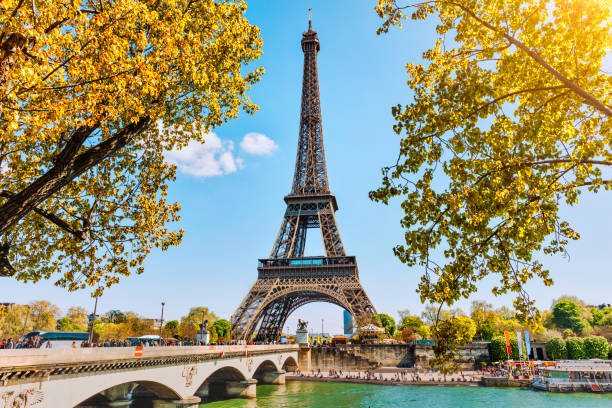
For the International Exposition of 1889, an exhibition showcasing global achievements and progress, Paris needed a striking monument that would draw the world’s attention. To find the ideal centerpiece, a competition was held, rejecting over 100 proposed projects–except for one. This eye-catching project is now commonly known as the Eiffel Tower.

Although the Eiffel Tower was named after Gustave Eiffel (a civil engineer), several other contributors worked to plan and execute the design and construction of this spectacle. These contributors include Maurice Koechlin, Emile Nouguier, and Stephen Sauvestre.
Engineering Components of the Eiffel Tower
The Eiffel Tower, rising 300 meters tall excluding the TV antenna, needed critical foundations to provide stability underneath the structure. The foundations were dug 7 meters underground with beds of 2-meter thick concrete slabs under the feet. Hydraulic jacks were also installed at the base of each leg and could adjust the first floor’s level, which made sure that the tower wouldn’t lean over. As the main body of the tower was being built, creeper cranes were needed to reach the high levels.

Open-lattice wrought iron, consisting of shapes including triangles and parallelograms, was used to make up most of the Eiffel Tower. The latticework reduced the weights of the parts while making structure stronger.
Gustave Eiffel also checked that the tower’s curvature was as wind resistant as possible. As Eiffel states, “All the cutting force of the wind passes into the interior of the leading edge uprights.” The engineer claimed that if lines are drawn tangent–tangent meaning a line touching a curve at one location without crossing through–to each upright part of the tower at the same height, then those lines will meet at a second spot where the wind arriving from a higher section of the tower will flow through. Eiffel finishes his explanation: “Before coming together at the high pinnacle, the uprights appear to burst out of the ground, and in a way to be shaped by the action of the wind.”
Like many structures, the Eiffel Tower experiences thermal expansion. In other words, the tower expands or contracts depending on the temperature.

Artistic Elements of Design
While the Eiffel Tower sure was great in terms of height, it needed to look appealing as well. Consequently, the French architect Stephen Sauvestre was tasked to work on the tower’s appearance. According to La Tour Eiffel, Sauvestre suggested adding arches to link the columns and first platform level. He also wanted glass walls decorating each level’s halls and the top of the tower to be shaped like a bulb. In the end, only a few of Sauvestre’s plans were kept (including the arches) which gave the tower a classy and elegant touch.
The images below are some of the blueprints and designs used for the tower.


From our observations, the Eiffel Tower’s structure is particularly symmetrical; put simply, both halves of the tower appear identical. This could have been a purposeful design choice to create a cohesive and unified building.
Initial Controversy and Unpopularity
Despite the effort that was put into the Eiffel Tower’s appearance, many well-known critics disliked the tower’s style in the late 19th century. For example, writer Léon Bloy referred to the building as a “truly tragic street lamp” while art critic and French novelist Joris-Karl Huysmans called it “a suppository riddled with holes.”
On February 14, 1887, protests against the tower’s style and aesthetics were published in the newspaper Le Temps. These protests took place while the tower was still under construction. The complaints were signed by numerous famous names associated with the arts including Charles Gounod, Guy de Maupassant, François Coppée, and Leconte de Lisle.
Gradual Effect on the Industry of Art

Although the Eiffel Tower faced initial negative backlashes, it outlasted numerous objections.
The tower was featured in many works of art. Georges Seurat, a famous French artist, painted the Eiffel Tower (as shown on the left) using the pointillism technique. Writers including Blaise Cendrars, Guillaume Apollinaire, Louis Aragon, and Roland Barthes were also inspired by the Eiffel Tower, leading to the tower starred in countless poems.
To conclude, the Eiffel Tower was built due to the International Exposition of 1889, in which it was selected from more than 100 projects. Having faced heavy criticism for its appearance during the early stages of construction, it eventually won the hearts of many citizens. The Eiffel Tower now serves as an iconic landmark of Paris, representing an architectural wonder of art.
References
- “The Eiffel Tower.” Wonders of World Engineering. https://wondersofworldengineering.com/eiffel_tower.html
- John Leicester. “Eiffel’s Popularity Continues to Rise.” The Washington Post. https://www.washingtonpost.com/archive/politics/2003/01/26/eiffels-popularity-continues-to-rise/13b4130f-f718-4c78-b703-f33007cebd4a/
- “Gustave Eiffel.” Britannica. https://www.britannica.com/biography/Gustave-Eiffel
- “Art and the Eiffel Tower.” La Tour Eiffel. https://www.toureiffel.paris/en/the-monument/art-and-eiffel-tower
- “Origins and Construction of the Eiffel Tower.” La Tour Eiffel. https://www.toureiffel.paris/en/the-monument/history
- Patel, M. “Eiffel Tower.” Purdue University. https://engineering.purdue.edu/MSE/aboutus/gotmaterials/Buildings/patel.html
- “How was the Eiffel Tower built?” BBC Earth Science. https://youtu.be/9W8qkf96Hp8?si=ZN3hGJ5xa9yfAnBa


Leave a Reply