Despite Black History Month coming to a close, the legacy left by a multitude of black trailblazers in the STEAM industry should never be forgotten. Through this article, we’ll explore and celebrate the diverse lives and accomplishments of black people from across the globe.
Marie M. Daly

PC: The Rockefeller University
Born on April 16, 1921, Marie M. Daly was an American biochemist and the first Black woman to earn a Ph.D. in chemistry in the United States. She came from a family that greatly valued education, helping boost her desire for learning.
During her life, Daly’s research helped to disclose the relationship between high cholesterol and clogged arteries when studying the causes of heart attacks; this finding greatly contributed to the understanding of how foods and diet can affect the health of the heart and the circulatory system.
Daly not only contributed to research projects but she also taught biochemistry courses, as she cared deeply about giving scholarly opportunities to people of color for enrolling in medical schools and graduate science programs. In 1988, she even started a scholarship in honor of her father for minority students who want to study science at Queens College.
Otis Boykin

Born on August 29, 1920, Otis Boykin was an American inventor and engineer. He attended Booker T. Washington High School in Dallas, where he graduated as valedictorian in 1938.
During his life, Boykin made significant improvements to electrical components, including resistors, and helped advance the function control of electronic circuits in a variety of products such as televisions and computers. His mother’s unfortunate death inspired him to improve the cardiac pacemaker medical device, where one of Boykin’s resistors was used as a control unit for the first successful implantable pacemaker.
Overall, Boykin received eleven patents and invented around 26 electronic devices, ranging from resistors to chemical air filters, to a burglar-proof cash register.
Edmonia Lewis

Born on July 4, 1844, Edmonia Lewis was a sculptor of mixed African-American and Native American (Mississauga Ojibwe) heritage. Lewis led a harsh upbringing as she lost both of her parents and faced racial discrimination starting at a young age. Yet, that didn’t stop her from pursuing her love for art.

She enrolled in Oberlin College, one of the few institutions that admitted Black students at the time. Lewis became the first African-American and Native-American sculptor to achieve national and international prominence. She remained the only Black female artist who had participated in and been recognized by the American artistic mainstream. Inspired by Abraham Lincoln’s Emancipation Proclamation, she carved Forever Free (1867), one of her most well-known works.
Philip Emeagwali

Born on August 23, 1954, Philip Emeagwali is a computer scientist from Nigeria. Growing up, Emeagwali was often considered a prodigy by his family and neighbors due to his noteable math skills. However, continuing his early schooling quickly became problematic due to the Nigerian Civil War. After self-studying years later, Emeagwali passed a high school equivalency exam administered by the University of London in 1973, allowing him to travel to the United States to attend Oregon State University in 1974.
Emeagwali’s work mainly focused on the oil discovery problem where he used thousands of widely distributed microprocessors to perform his calculations. He was able to run more than 3.1 billion calculations per second and correctly identified the amount of oil in a simulated reservoir.
However, Emeagwali’s primary achievement wasn’t about oil. He introduced a practical and inexpensive way to allow computers to communicate and collaborate with one another all around the world; the key to his achievement was programming each microprocessor to communicate with six neighboring microprocessors simultaneously. This discovery later helped lead to the development of the internet, earning Emeagwali the Institute of Electronics and Electrical Engineers’ Gordon Bell Prize in 1989.
Evelyn Boyd Granville
Born on May 1, 1924, Evelyn Boyd Granville was a mathematician and computer scientist recognized for being one of the first African American women to receive a doctoral degree in mathematics and the second African-American woman to receive a Ph.D. in mathematics from an American university. In fact, she achieved a double Master’s degree in mathematics and physics from Yale University in just one year!
Granville worked at IBM, a global technology company, in the early days and made significant contributions to the program developments for the Vanguard and Mercury spaceflight projects. Additionally, she dedicated many years of her life to teaching mathematics at the college level, inspiring numerous students to pursue their dreams in the computing field.
Granville founded the National Association of Mathematicians (NAM) Committee on Equal Opportunities for Women, advocating for gender equality in mathematics. Throughout her career, she received numerous awards and honors, including the Wilbur Lucius Cross Medal from Yale University and the National Academy of Sciences Award for Communication.
Jacob Lawrence

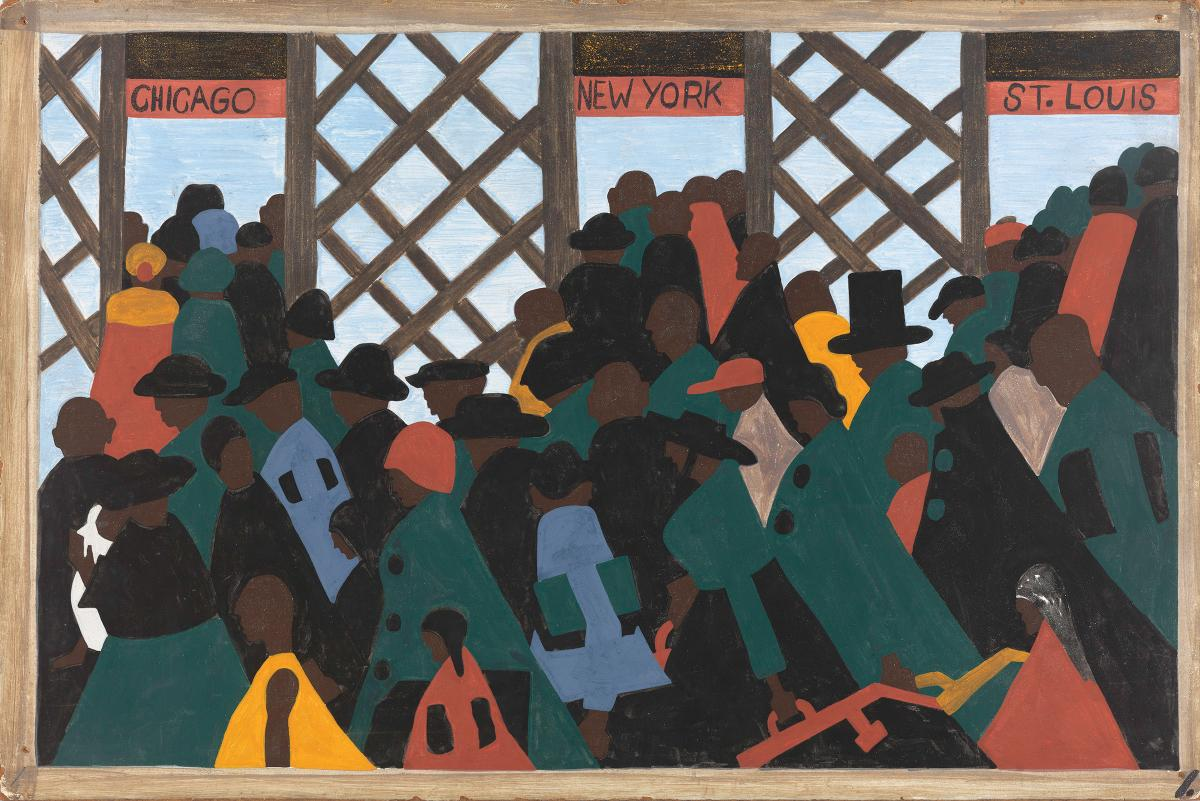
Born on September 7, 1917, Jacob Lawrence was an American painter known for his portrayal of African-American historical subjects and contemporary life and as one of the leading figures of 20th century art. He began painting at a young age and was greatly influenced by the Harlem Renaissance, a cultural and artistic movement that celebrated African-American art and culture in the 1920s and 1930s.
Some of Jacob Lawrence’s famous works include:
The Migration of the Negro (1940-41)

It tells the story of the Great Migration: the movement of millions of African Americans from the rural South to the urban North during the early 20th century.
The Life of Frederick Douglass (1938)

It tells the story of Frederick Douglass: an abolitionist, writer, and statesman who escaped from slavery and became a leading voice for social justice.
The Life of Harriet Tubman (1939)

It tells the story of Harriet Tubman: a conductor on the Underground Railroad who helped enslaved people escape to freedom.
Nina Simone

Born on February 21, 1933, Nina Simone was an American singer, songwriter, pianist, composer, arranger, and civil rights activist.
Her music became a form of black empowerment, as most of her songs often carried meaningful messages that resonated-and still resonate-with black people. She was a classically trained child and possessed immense musical talent, which she made sure to utilize to help amplify her voice alongside the voices of others. Popular songs of hers include “Mississippi Goddam,” “To Be Young, Gifted and Black,” and “Feeling Good,” all of which became anthems of the Civil Rights Movement.
George Washington Carver

George Washington Carver was a scientist and inventor who made significant contributions to agriculture and society.
Despite being born into slavery, Carver demonstrated a deep curiosity about the natural world and had a strong passion for learning. Even though he occurred multiple hardships throughout his educational journey, Carver managed to earn a bachelor’s and master’s degrees in agriculture, becoming the first Black student to do so at Iowa State College.
He made significant developments in agriculture by creating new products derived from peanuts, sweet potatoes, and soybeans as alternatives to cotton, which had depleted the soil. Through these developments, the quality of the crops improved tremendously, later allowing Carver to develop hundreds of products from these crops, including paints, cosmetics, medicines, and even plastics.
Black Excellence in STEAM
These individuals and many others show how powerful the black community is. It’s essential to appreciate the major contributions that the black community has placed upon our world, not only during Black History Month, but always. I encourage you to look more at the achievements made by the black community and to share your knowledge with friends and family.
Together, we can prove that no matter the race, there can always be more steps taken to protect our Earth, raise awareness on societal issues, and improve the standards of living for individuals across the world.
References
- “Marie M. Daly.” Biography, Biography, 12 Jan. 2021, www.biography.com/scientists/marie-m-daly. Accessed 6 Mar. 2024.
- Wikipedia Contributors. “Otis Boykin.” Wikipedia, Wikimedia Foundation, 23 Feb. 2024, en.wikipedia.org/wiki/Otis_Boykin. Accessed 6 Mar. 2024.
- “Otis Boykin | Biography, Resistor, Pacemaker, & Facts | Britannica.” Encyclopædia Britannica, 2024, www.britannica.com/biography/Otis-Boykin. Accessed 6 Mar. 2024.
- Wikipedia Contributors. “Edmonia Lewis.” Wikipedia, Wikimedia Foundation, 28 Feb. 2024, en.wikipedia.org/wiki/Edmonia_Lewis. Accessed 6 Mar. 2024.
- Wikipedia Contributors. “Philip Emeagwali.” Wikipedia, Wikimedia Foundation, 28 Feb. 2024, en.wikipedia.org/wiki/Philip_Emeagwali#:~:text=Court%20of%20Appeals.-,Supercomputing,about%20400%20Mflops%2F%241M. Accessed 6 Mar. 2024.
- https://www.facebook.com/thoughtcodotcom. “Philip Emeagwali, Nigerian American Computer Pioneer.” ThoughtCo, 2019, www.thoughtco.com/philip-emeagwali-4689182. Accessed 6 Mar. 2024.
- Wikipedia Contributors. “Evelyn Boyd Granville.” Wikipedia, Wikimedia Foundation, 6 Mar. 2024, en.wikipedia.org/wiki/Evelyn_Boyd_Granville. Accessed 6 Mar. 2024.
- “Evelyn Granville | Biography, Contributions to Mathematics, & Facts | Britannica.” Encyclopædia Britannica, 2024, www.britannica.com/biography/Evelyn-Granville. Accessed 6 Mar. 2024.
- “Jacob Lawrence | Biography, Art, & Facts | Britannica.” Encyclopædia Britannica, 2024, www.britannica.com/biography/Jacob-Lawrence. Accessed 6 Mar. 2024.
- “Jacob Lawrence | Biography, Art, & Facts | Britannica.” Encyclopædia Britannica, 2024, www.britannica.com/biography/Jacob-Lawrence. Accessed 6 Mar. 2024.
- “Nina Simone | Facts, Biography, & Music | Britannica.” Encyclopædia Britannica, 2024, www.britannica.com/biography/Nina-Simone. Accessed 6 Mar. 2024.
- “George Washington Carver | Biography, Education, Early Life, Inventions, & Facts | Britannica.” Encyclopædia Britannica, 2024, www.britannica.com/biography/George-Washington-Carver. Accessed 6 Mar. 2024.


Leave a Reply