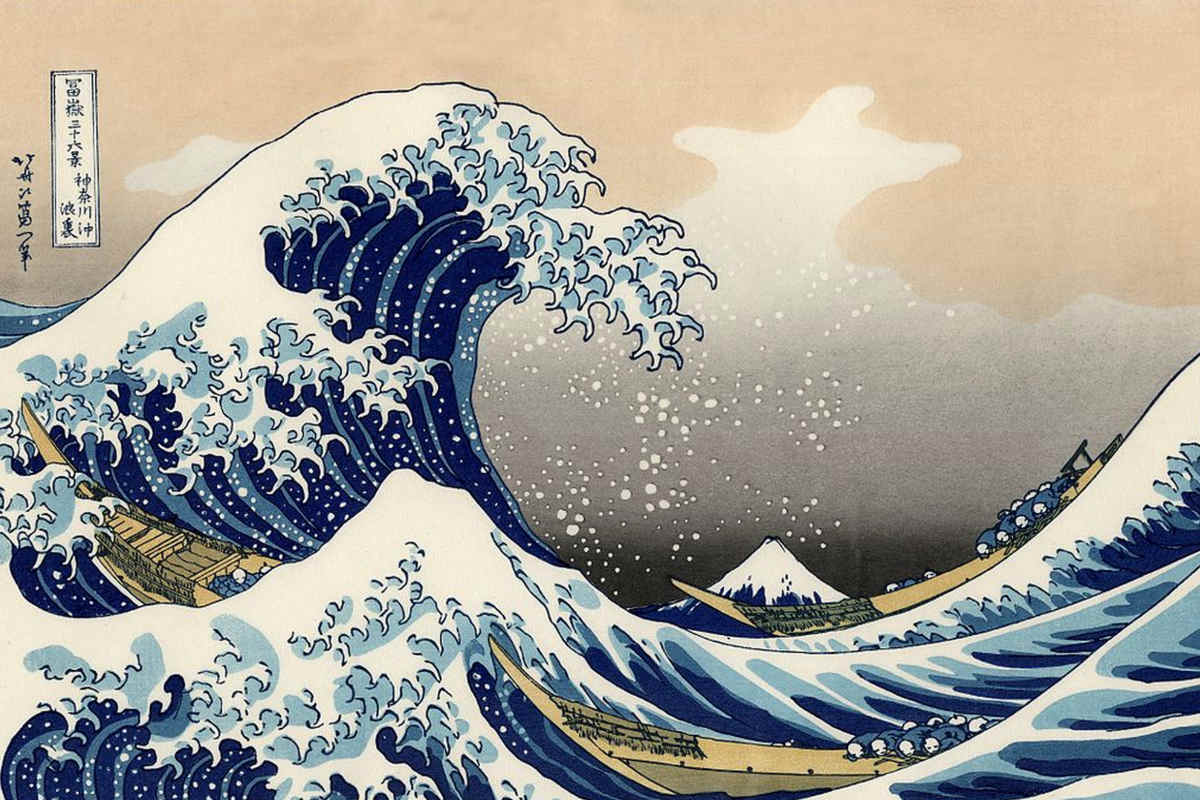
During winter break between 2023 and 2024, I traveled to the beach of Santa Marta in Colombia. While being at the beach has always been a philosophical experience for me, this time my reflection pertained to the waves of the ocean. It didn’t strike me until my little cousin asked me about the origin of waves, but my only clear reference was my tenth grade physics class and The Great Wave painting by Katsushika Hokusai. At this point, I knew that I wanted to explore both the science behind waves and how this essential phenomenon of the natural world is represented in art and consequently, in our minds.

What are waves?
First, giving an answer to my little cousin, “waves” is not only a denomination for sea waves, but also for light, sound, and the motion of subatomic particles. Simply stated, it is a disturbance in a natural state that propagates, normally carrying energy but not matter. There are two main kinds of waves: transverse and longitudinal. The sea waves are transverse, meaning that while the energy is propagating in one direction, the motion of the particles in the wave (water in this case) are moving transverse to the propagation sense. That is why waves move energy forward but the particles move up and down, explaining their recognized motion.
Types of sea waves
By knowing the general principles for physical waves, we can understand better why sea waves carry energy, and not water itself. The most common types of sea waves are wind-driven, tsunamis, and tides. Wind-driven waves are the most common ones: the ones we saw when we were at the beach. They are caused by wind blowing in different directions and magnitudes over the sea while generating the disturbance previously mentioned. Therefore, the wave height depends directly on the amount of energy transferred by the wind through both pressure and friction between both fluids–water and air. They break when their steepness is very high compared to their wavelength or due to the interference of the sand in the forces.
The other two kinds of ocean waves are caused by gravitational forces from the sun and the moon (mainly tidal) and by geological disturbances. The firsts, tidal, are impressive since the gravitational force of the moon generates bulks of water on one side or the other of Earth which gives us the impression of high and low tides. This, in consequence, generates long tidal waves that extend al throughout the same “gravitational field”.

Artistic depiction of waves
Although there are numerous scientific depictions of waves, it is important to recognize the intersection between the physical world and the artistic one–since every explanation was once just a creative idea. We’ve learned that in waves we have energy; we have a permanent wave-producing machine that can save us from extreme nihilism, which according to the Stanford’s Philosophical Encyclopedia, has contributed to the rise of modernity’s signature feelings of anxiety, alienation and boredom, since it supports the perspective of nothing mattering, and in morality that nothing is moral.
One archetype seen in most paintings with waves is that they are portrayed as an obstacle to overcome; they are depicted in storms with boats that seem to be very vulnerable to drowning due to the dynamism represented by the natural phenomenon.
Yet, ironically, another trait is that they are usually seen alongside sunsets or with the tiniest bit of warm colors and tones in the background, typically representing a glimmer of hope. Similarly, the way we see waves at ashore is also another representation of that: we step close enough, water will eventually drown our feet, but the wave eventually recedes and leaves our feet intact, as does to our footsteps on the sand; it erases them completely, but one can always make it again.

The Ninth Wave, Hovhannes Aivazovsky
This multiple interpretations of waves throughout paintings could have never been seen without the help of artists who know how to efficiently trade emotions using color and form. Especially when being represented in a static image–which I think is the most admirable thing from these masterpieces–is that waves tend to hold the feeling of being alive; as if our eyes had captured the image or we had done a virtual redo of one wave with all its numbers.
With waves we can also understand how anything can be a part of everything. We can see that every tiny wave is a part of the ocean because of its ability to rise and fall without ever leaving it,. allowing it to come down and reunite–not really, just hug tighter–with Earth as a whole.
Furthermore, this easily connects with the scientific explanation, because indeed, waves are simply another part of the energy that the wind carries, another part of the gravitational pull that keeps the moon surrounding us, and another one of the effects of Earth accommodating itself. Waves as physical events show to be connected to many factors, especially reminding us that we are too.
Japanese interpretation of waves
Waves are significant in Japanese culture. This cultural impact seems to be depicted in paintings previously noted on, since, for instance, the contrast between the yin and yan is represented by the dynamic and erratic wave contrasted by the background which is normally empty and calm. This contrast is relevant culturally due to the belief of interactions between opposites being a fundament of life, existence, and the universe.

The Great Wave, Katsushika Hokusai
How can we efficiently use waves?
To conclude, let’s evaluate waves as an energy source. Even though waves are renewable, they’ve now become controversial due to underwater-land ownership as well as the detrimental impacts on the environment because of very naïve technology. Despite this, scientists agree on the benefits of using tidal energy rather than wind energy. Since water is denser than air and both are generated by turbines, waves can turn the turbines easier and more effectively; tidal energy has more power than wind energy.
It has its pros and cons, yet most of its cons we can solve through the study of the waves and the combination of engineering with creatives that are able to find a solution for our crisis.
References
- Concerning Reality (2019). How do Ocean Waves Work? https://www.youtube.com/watch?v=_LRc6k-clzE&ab_channel=ConcerningReality
- Editors of Encyclopaedia Britannica (2024). wave. Britannica. https://www.britannica.com/science/wave-physics
- Lattarulo, M. T (2020). Waves in Japanese Art. Arte in Giappone. https://arteingiappone.altervista.org/en/waves-in-japanese-art/
- NOAA (2023). Why does the ocean have waves? National Ocean Service. https://oceanservice.noaa.gov/facts/wavesinocean.html
- Pizzo, N. Deike, L. Ayet, A. (2021). How does the wind generate waves? Physics Today 74 (11). https://pubs.aip.org/physicstoday/article/74/11/38/386739/How-does-the-wind-generate-waves-Although-the
- Rutledge, K. McDaniel, M. Teng, S. Hall, H. Ramroop, T. Sprout, E. Hunt, J. Boudreau, D. Costa, H. (2023). Tidal Energy. National Geographic. https://education.nationalgeographic.org/resource/tidal-energy/
- s/n (s.f). Waves depicted through art.. Google Arts & Culture. https://artsandculture.google.com/usergallery/waves-depicted-through-art/7ALCHioaRXMHJA
- s/n (2005). Waves in the Ocean. Florida Center for Instructional Technology. https://fcit.usf.edu/florida/teacher/science/mod2/waves.html


Leave a Reply