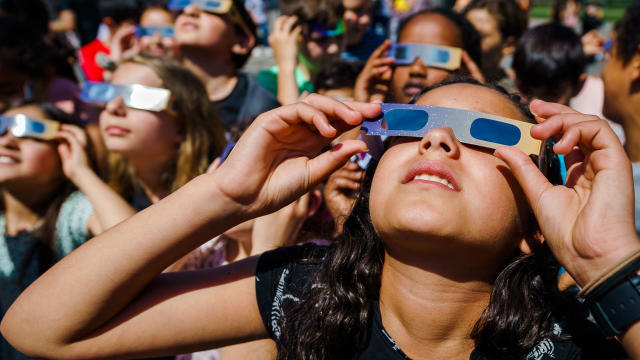
Picture this: you look outside and notice that the sky has darkened but it’s only 12pm! Although this seems straight out of a science fiction book, the phenomenon known as a Solar Eclipse is nothing less than a real life occurrence happening in the upcoming year. As we look forward to this event on April 8, 2024, let’s first learn how solar eclipses play a critical role in modern media, art, and the STEM field.

What Is A Solar Eclipse?
A solar eclipse happens when the moon passes right in front of the sun, causing the sun’s UV rays to be blocked from reaching Earth. Consequently, different regions of the Earth will see different “versions” of the eclipse depending on the path of totality.
Solar eclipses are rare and many factors influence their occurrence. The moon is elliptical, which means that one side of the moon is closer to Earth than the other. This happens because of the gravitational pull of the Earth and the Sun. Because Earth has a stronger gravitational pull, one side of the moon tends to lean more towards Earth. Thus, the size of the moon’s appearance to an observer on Earth varies. A total solar eclipse occurs when the moon is large enough to cover the sun. The rate of a total solar eclipse varies throughout the years. In fact, the last total solar eclipse was seven years ago during 2017!
Path of Totality
The areas on Earth where the solar eclipse is visible are called the paths of totality. The path of totality occurs when the sun’s shadow is cast on Earth, causing only the observers who are in the path to be able to see the total solar eclipse.
Fun Fact: The beauty of a solar eclipse had “twenty-one million adults” travel into the path of totality in 2017. 1
What about observers outside the path of totality? Well, they only see a partial solar eclipse. A partial solar eclipse appears when the moon doesn’t cover the entire sun; instead, a crescent of the sun remains uncovered.

Combining Technology and Solar Eclipses
Technology has played a huge role in viewing solar eclipses. For example, solar viewing glasses protect their users from the effects of staring directly into the sun without protection. The glasses work by filtering the sunlight rays to a safe level, allowing people to view the solar eclipse while protecting them from eye injuries such as blindness and retinal burns.

The glasses should be worn at all times outside the path of totality. However, they are not required when the moon covers the sun entirely (found only inside the path of totality).
Mathematics in the Solar Eclipse World
To many peoples’ surprise, scientists and researchers use mathematics to study and understand solar eclipses.
For example, scientists use geometry to calculate the path of totality. They predict this by using the angles of the Moon, Sun, and Earth to calculate the next eclipse and path of totality.
Another instance of this intersection includes the study of Kepler’s Laws. According to NASA, Kepler’s laws describe how planetary bodies orbit the sun. His equation, P² = a³ is used to calculate a planet’s average orbital speed.
The Art of Solar Eclipses
Solar eclipses are often seen in artwork and cultures. In Chinese mythology, it is believed the solar eclipse is a result of an invisible dragon swallowing the sun. It states that the invisible dragon will only be cast off if drummers create enough noise and archers shoot arrows in the sky.

Alongside cultural perspectives, many artists use solar eclipses as inspiration in their work. For instance, some artists use solar eclipses to highlight a contrast between lightness and darkness.
Renaissance artists particularly used this natural phenomenon in religious contexts. The solar eclipses in the artwork symbolized “unparalleled darkness and anguish”1

What’s next?
Luckily for us, the next total solar eclipse will be happening this year! The date for the next total eclipse is April 8, 2024. According to the Washington Post, “the path of totality will stretch roughly 100 miles from northern Mexico through Texas, New England, and to the North Atlantic”2.
References
- “What Is a Solar Eclipse? | NASA Space Place – NASA Science for Kids.” Nasa.gov, 2023, spaceplace.nasa.gov/eclipse-snap/en/. Accessed 12 Jan. 2024.
- “What Is Lunar Perigee and Apogee?” Timeanddate.com, 2024, www.timeanddate.com/astronomy/moon/lunar-perigee-apogee.html#:~:text=The%20Moon’s%20orbit%20around%20Earth%20is%20elliptical%2C%20with%20one%20side,to%20the%20center%20of%20Earth. Accessed 12 Jan. 2024.
- “What Is a Partial Solar Eclipse?” Timeanddate.com, 2024, www.timeanddate.com/eclipse/partial-solar-eclipse.html. Accessed 12 Jan. 2024.
- “NASA Eclipse Science – NASA Science.” Nasa.gov, 24 Feb. 2022, science.nasa.gov/eclipses/nasa-research/. Accessed 12 Jan. 2024.
- “A Record Number of Americans Watched the 2017 Solar Eclipse—and Sought Science Afterward.” University of Michigan News, 13 Aug. 2018, news.umich.edu/a-record-number-of-americans-watched-the-2017-solar-eclipse-and-sought-science-afterward/. Accessed 12 Jan. 2024.
↩︎ - Sama Shahrouri. “Eclipses throughout Art History – Artmejo.” Artmejo, 27 July 2018, artmejo.com/eclipses-throughout-art-history/#:~:text=In%20Renaissance%20art%2C%20the%20eclipse,in%20the%20Gospel%20of%20Luke*. Accessed 12 Jan. 2024.
*. ↩︎ - Patel, Kasha. “There’s a Total Solar Eclipse Coming Soon. Here’s Everything You Need to Know.” Washington Post, The Washington Post, 2 Jan. 2024, www.washingtonpost.com/weather/2024/01/02/total-solar-eclipse-path-april/. Accessed 12 Jan. 2024.
↩︎


Leave a Reply