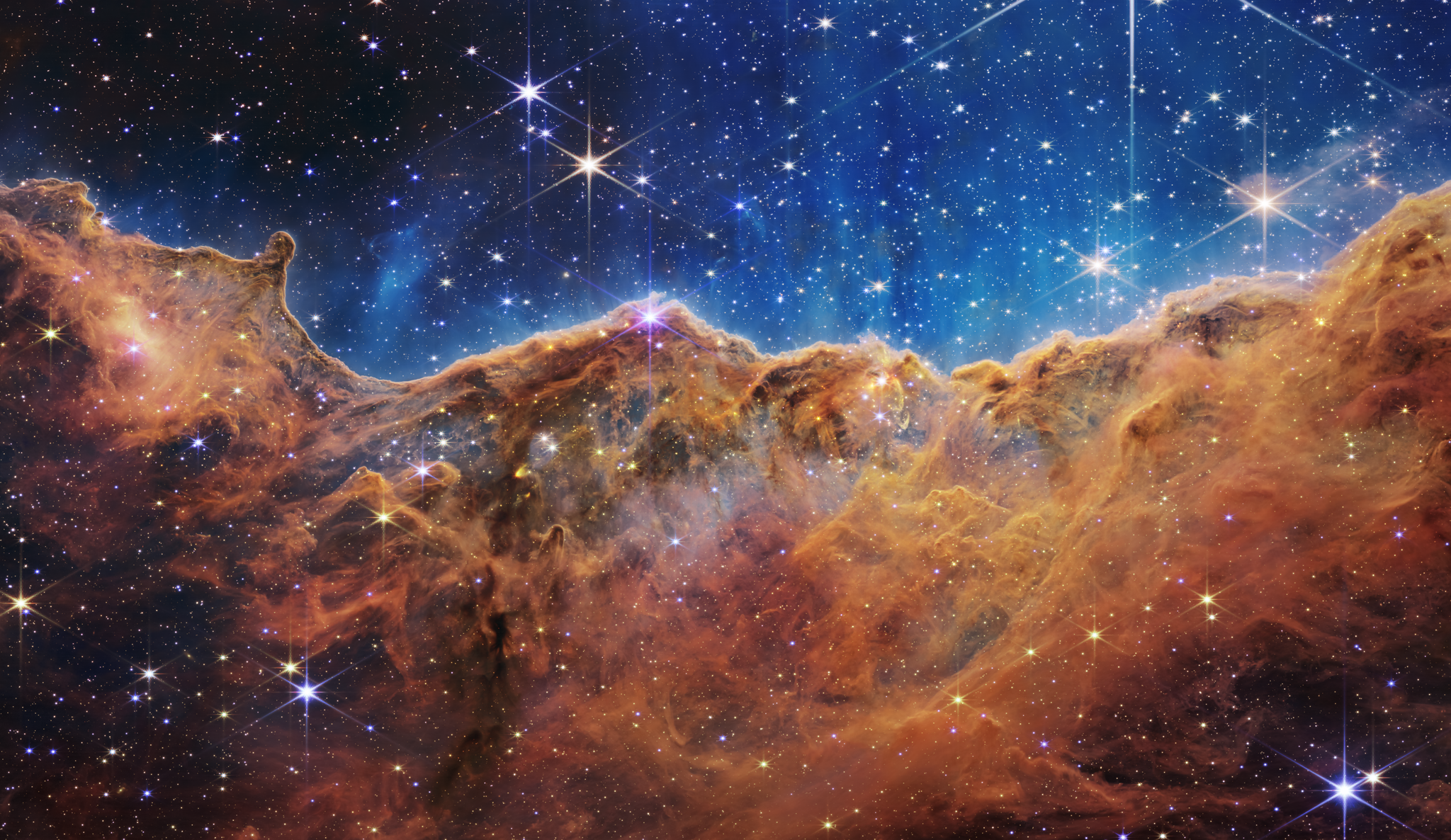
Whether you’re looking for a galaxy picture to add to your school’s science project or wondering what NASA’s Hubble Space Telescope saw on your birthday, it’s difficult to miss the beauty of the fascinating space discoveries captured by NASA each day. But how accurate are these photos really?
Where are Hubble and Webb?
NASA’s Hubble Space Telescope alongside its successor, the Webb Space Telescope, have been two of the strongest sources of astronomy photography since their launches in 1990 and 2022, respectively.
While the Hubble Telescope orbits the Earth at approximately 354 miles above the Earth’s surface, the Webb Telescope orbits the sun at the Second Lagrange point (L2), approximately 1 million miles away from Earth. The Second Lagrange point is a point located between the Sun and the Earth where the gravitational pull coming from each large mass is strong enough to keep a small object moving in a consistent motion alongside them.

Wait, it’s not colorful?
It’s hard to not find yourself intrigued by the multitude of colors found in NASA’s space photos but would it surprise you to know that all of the photos taken by the Hubble and Webb Telescopes are actually sent back to NASA in Black and White? Although the telescope cameras can detect any light that comes through, special color filtering aids the separation of wanted and unwanted light, preventing color from being recorded and thus releasing images in only black and white.
Colorizing Images
How exactly does NASA add such vibrance to their images if they’re given only black and white photographs? NASA utilizes a process known as colorizing which helps to add color to black-and-white images.
The first step to colorizing these images is by creating three separate colored exposures of the original image: one colored in red, one in blue, and one in green. Why these colors? Red, blue, and green are known as the primary colors of light which ultimately make up every color that is visible to the human eye. By using these base colors, NASA’s imaging specialists can easily adjust the intensity of each color to generate new shades and colors to highlight the details of the photographs.
Once the exposures are created, the colorized images are layered on top of one another to create an overall “base” image. At this point, imaging specialists must modify different elements of the image such as the amount of light that is filtered through or the number of levels that a specific color uses in order to best accentuate the detail of the image.

Why is colorizing space images so important?
Not only does colorizing these photos create a more visually appealing outlook on astronomical discoveries, but it also helps to highlight the details in images that would be far more challenging to see otherwise. Colorizing in the space industry helps to bring what started as a colorless image into a snapshot full of exuberance, making it more engaging to the human eye.
One of the most significant aspects of colorizing is its merging of the Arts and Sciences. Although there are numerous technicalities in creating the technological processes that execute the photography itself, the technique of colorizing the images in order to bring out certain details within the image subject requires an area of creativity more commonly found in the Arts industries.
It’s just colors, how hard can it be? Unless you’re a NASA imaging specialist, colorizing such intricate photography is certainly not easy. Layering certain colors, adjusting color hues, and modifying underlying color tones are essential towards bringing out key features in a photograph; these are just some of the many ways in which the creative mind is used to develop such flamboyant images. To have the responsibility of colorizing these images demands an awareness of how colors are portrayed relative to one another in order to truly emphasize the details within astronomical discoveries.
Sources
- “The Meaning of Light and Color.” Hubble, Q Starter Kit, 2018, hubblesite.org/contents/articles/the-meaning-of-light-and-color. Accessed 22 Aug. 20
- “How Are Webb’s Full-Color Images Made?” Webb, Q Starter Kit, 2022, webbtelescope.org/contents/articles/how-are-webbs-full-color-images-made#:~:text=Webb’s%20raw%20telescope%20images%20initially,is%20poured%20into%20each%20step. Accessed 22 Aug. 2023.
- “Orbit-Webb/NASA.”Nasa.gov,2023, webb.nasa.gov/content/about/orbit.html#:~:text=The%20James%20Webb%20Space%20Telescope,second%20Lagrange%20point%20or%20L2. Accessed 22 Aug. 2023.


Leave a Reply